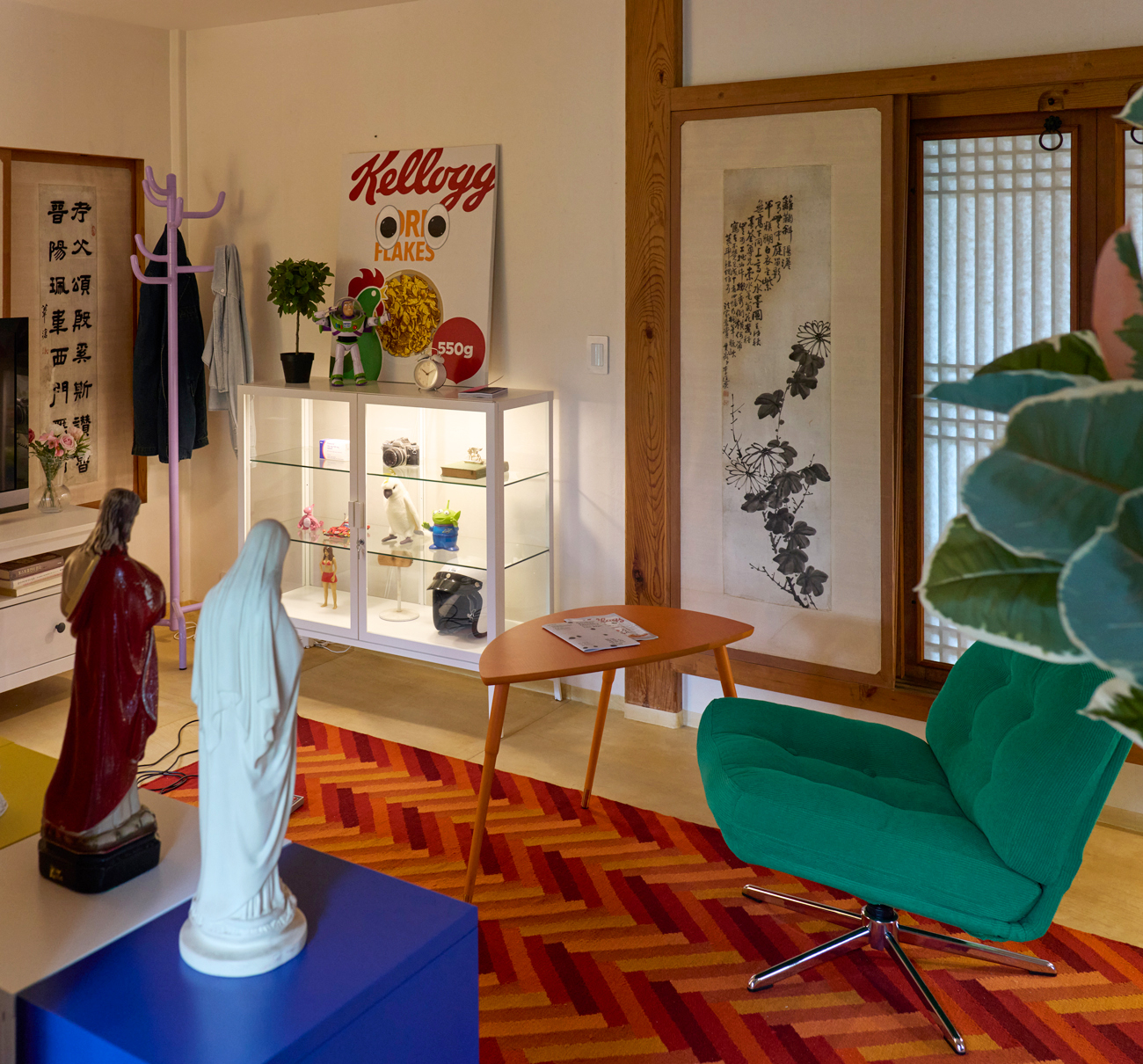
Fantasy Dream
Fantasy Dream, 2024, IKEA furniture, mixed media, dimension variable.
Exhibition:
Random Access Memory, Chapter 3: Record & Memory, House of Woonkyung, 2024 ︎
이완은 한국인의 내면에는 서로 다른 양식과 세계관이 역사적 변화를 거치며 중층적으로 자리 잡아 왔고, 이들이 충돌하며 독특한 혼종적 감각을 형성해 왔다고 말한다. 이는 우리가 스스로를 인식하는 과정에서 단일한 관점이 아니라, 서로 다른 시선과 판단 체계가 동시에 작동하고 있음을 의미한다.
일제강점기 강요된 근대화는 전통적 관념과 관계 중심적 시선을 해체하는 동시에, 서구적 시선을 외부에서 이식하는 과정이었다. 이 과정에서 한국 사회는 독특한 감각의 균열을 경험하게 된다. 우리는 서구식으로 ‘보는 방법’을 학습하면서도, 그 시선을 통해 스스로를 타자화하는 모순된 자기 객관화를 내면화하게 되었다. 이는 단순한 서구화가 아니라, 시선의 권력이 내부로 침투한 결과였다.
1980년대 후반 해외여행이 자유화되면서 사람들은 실제로 유럽을 방문하고, 사진으로만 접하던 서구적 모더니티를 직접 경험하게 된다. 이미 1970~80년대 고도성장을 통해 부를 축적한 계층의 라이프스타일은 유럽의 화려하고 웅장한 고전 양식을 지향하기 시작했고, 가구 회사들은 로코코 양식의 장식적인 가구와 액자, 조명 등을 모방해 대량 생산·판매했다.
사진 속 이미지로 존재하던 서구의 판타지는 현실의 공간 속으로 이식되었고, 이때 서구 모더니티는 더 이상 이미지가 아니라 실제로 소유되고 배치 가능한 대상으로 전환된다. 이는 단순한 취향의 변화가 아니라, ‘시선의 권력’이 실체화되는 결정적인 전환이었다. 이 시점을 기점으로 객관적 시선과 관계적 시선이 공존하는 이중적 인식 구조가 본격적으로 등장한다.
오늘날 한국의 도시 풍경은 이러한 내면의 구조를 그대로 드러낸다. 바우하우스의 영향을 받은 건축가에게 다시 영향을 받은 지역 건축가가 지은 빌라 안에는, 300년 전 유럽 귀족들이 사용했을 법한 화려한 아르누보 양식의 다리를 가진 식탁이 놓여 있다. 주방에는 ‘미니멀리즘’으로 위장한 가전제품이 자리하고, 그 위에는 로코코 스타일의 미니 샹들리에가 매달려 있으며, 거실에는 이케아 소파가 놓여 있다. 그 뒤편에는 거대한 동양화 액자가 벽을 채우고 있다.
이것이 오늘날 한국의 독특한 풍경이다. 이완은 이러한 혼종적 양식이 단순한 취향의 혼란이 아니라, 근대화와 식민지 경험, 세계화가 중첩되며 형성된 한국인의 모순적인 내면 구조를 반영한다고 말한다. 이러한 감각은 한국만의 특수한 현상이 아니라, 식민지 경험을 거치며 자발적인 근대화를 완수하지 못했던 아시아 국가들 전반에서 공통적으로 나타나는 감각 구조이기도 하다.
작가는 이러한 혼종적 풍경을 실제 전통 한옥의 내부에 연출하는 작업을 통해, 우리에게 익숙하지만 동시에 낯설게 느껴지는 감각들의 배치를 드러낸다. 이는 단순한 양식의 충돌이 아니라, 시선과 욕망, 기억과 판타지가 어떻게 공간 속에서 조직되고 작동하는지를 드러내는 감각의 장치에 대한 탐구다.
〈Fantasy Dream〉이라는 제목은 롯데월드의 어린이 어트랙션 놀이기구 이름에서 차용되었다. 이 놀이기구는 세계 각국의 역사적 상징물들이 초현실적으로 배열된 공간을 기차를 타고 이동하는 형식으로 구성되어 있다. 과자 나라, 마법의 세계 등 비현실적 풍경들이 현실 세계와 중첩되어 펼쳐지는 이 경험은, 이미지와 욕망, 판타지가 실제 공간 속에서 소비되는 방식을 상징적으로 드러낸다.)
Lee Wan suggests that the Korean psyche has been shaped through historical change by the layered accumulation of different styles and worldviews, which collide to form a distinctive hybrid sensibility. This means that self-perception operates not through a single viewpoint, but through multiple systems of vision and judgment functioning simultaneously.
Forced modernization during the Japanese colonial period dismantled traditional relational ways of seeing while imposing Western modes of perception from the outside. In learning how to “see” through a Western lens, Korean society internalized a paradoxical form of self-objectification—viewing itself as an other. This was not simply Westernization, but the internalization of the power of the gaze.
With the liberalization of overseas travel in the late 1980s, Western modernity—once encountered only through images—entered everyday life as something that could be owned, arranged, and inhabited. European classical styles were reproduced in furniture and domestic interiors, marking a shift in which visual power became materially embedded. From this point onward, objective and relational ways of seeing began to coexist.
Today’s Korean urban landscape reflects this layered structure: minimalist architecture influenced by Bauhaus principles coexists with Rococo-inspired furniture, mass-produced Scandinavian sofas, and large framed ink paintings rooted in East Asian tradition. These hybrid interiors reveal not confused taste, but the complex inner structure formed through modernization, colonization, and globalization—a condition shared by many Asian societies with similar histories.
By staging such hybrid scenes within the interior of a traditional Korean hanok, Lee reveals arrangements of sensation that feel both familiar and estranged. The work explores how gaze, desire, memory, and fantasy are organized and activated within space.
The title Fantasy Dream is borrowed from a children’s attraction at Lotte World, where fantastical landscapes and global symbols are arranged into a surreal journey. This reference points to the way images and desire are consumed and spatialized in contemporary life.